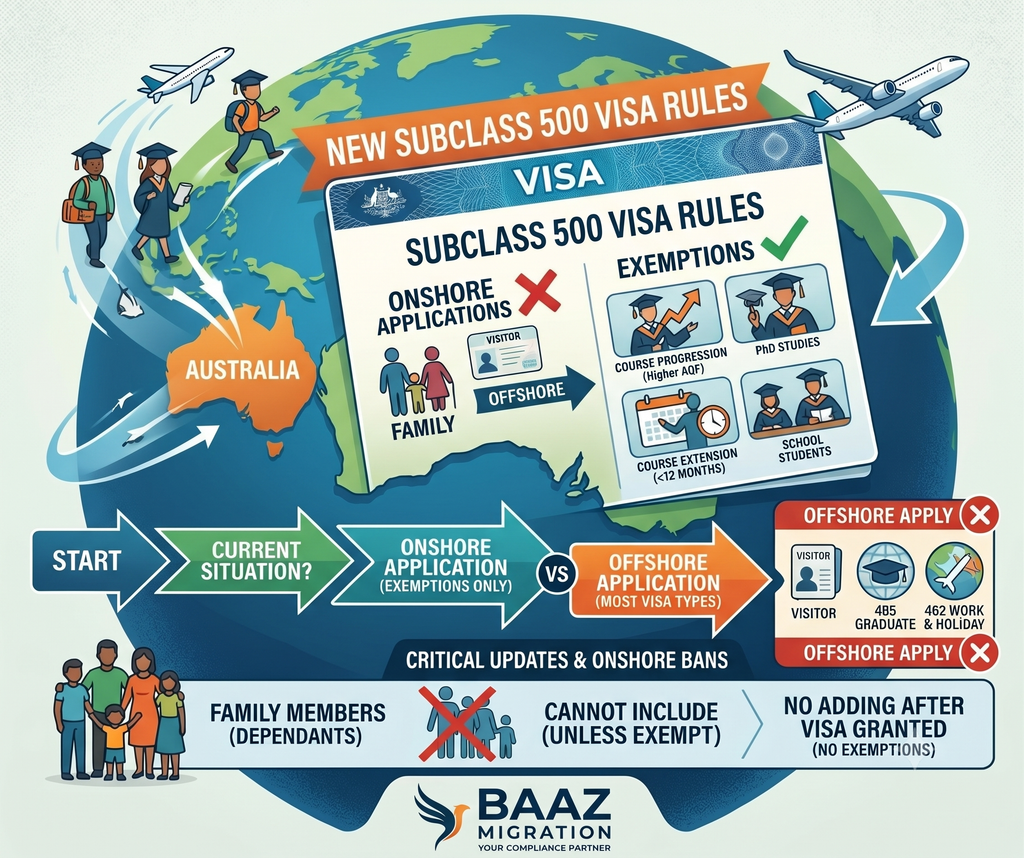
The Australian Government has introduced major reforms for international education through the Department of Home Affairs. Specifically, the Migration Amendment (Student Visa Reform) Regulations 2026 (LIN 26/102 and LIN 26/087) fundamentally transform the application process for the Subclass 500 Student Visa.
Consequently, these regulatory updates restrict onshore visa switching, reshape how students lodge further visa applications, and prohibit family inclusion in most scenarios.
1. Onshore Application Bans for Temporary Visa Holders (LIN 26/102)
First and foremost, most temporary visa holders in Australia can no longer lodge a Subclass 500 Student Visa application onshore. Therefore, under legislative instrument LIN 26/102, holders of specific visas must depart Australia before lodging a new student visa. In addition, applicants must remain offshore until the department decides on the visa grant.
The onshore application ban applies to:
- Visitor Visas: Subclasses 600, 601 (ETA), 602 (Medical Treatment), and 651 (eVisitor).
- Temporary Graduate Visa: Subclass 485.
- Work Visas: Subclasses 400, 407, 408, 482 (both Skills in Demand and former TSS), and 457.
- Working Holiday Makers: Subclasses 417 and 462.
- Other Visas: Specific 403 visas, 771 (Transit), 988 (Maritime Crew), and certain 995 visas.
As a result, lodging onshore while holding any of these visas creates an invalid application. Hence, you must lodge outside Australia and stay overseas until authorities finalise your visa.
2. Rules for Current Subclass 500 Holders: Can You Reapply Onshore?
Similarly, existing student visa holders face rigorous boundaries if they plan to stay in Australia. Thus, unless you qualify under an official exemption in LIN 26/087, you must leave Australia to apply for a further Subclass 500 visa.
Prescribed Onshore Exemptions (LIN 26/087)
However, you can still lodge your application onshore if you meet one of the following criteria:
- Course Progression (Higher AQF Level): You have finished your principal course and are advancing to a qualification at a higher Australian Qualifications Framework (AQF) level. However, note that higher education graduates must choose their next course from a higher education provider.
- Course Extension (Same Provider): You have started your main course, require up to 12 additional months past your original CoE end date to finish it, and remain with the exact same education provider.
- Doctoral Studies: You are actively enrolled in or are applying directly for a PhD program.
- School Students: You are entering primary or secondary school studies.
- Government Sponsorship: You hold formal sponsorship from either the Department of Foreign Affairs and Trade (DFAT) or the Department of Defence.
- Provider Default: Your education provider has defaulted and prevents you from completing your qualification.
- AQF Transitions: You finished school studies and are progressing to a non-AQF course, or you completed a non-AQF course and are entering an AQF program.
3. Strict Restrictions on Dependants and Family Members
Furthermore, the new framework significantly tightens rules for family members and dependants:
- No Subsequent Entrants: Current student visa holders can no longer bring family members after securing their visa. Moreover, the department offers zero exemptions to this rule.
- No Dependants at Application Stage: General applicants can no longer include spouses, partners, or children in their original application unless they meet distinct exemptions.
Permitted Family Inclusion Exceptions
Nevertheless, certain applicants may still include their immediate family members:
- Doctoral candidates enrolled in a PhD course.
- Students with foreign government, DFAT, or Defence sponsorships.
- Eligible students from ASEAN member countries or Pacific nations.
- Dependants of existing students whose providers defaulted, or whose primary visa holder needs an extension to finish a principal course.
Important: In every exempt case, the main applicant and all dependants must lodge the application while standing in the exact same location (both onshore or both offshore).
4. Key Deadlines and Grandfathering Rules
Fortunately, the Department of Home Affairs continues to process applications lodged prior to 2 October 2026 under the previous framework. However, officers will assess every application lodged on or after this date under these stringent new requirements.
Plan Your Study Pathway with Baaz Migration
Because Australian immigration law is evolving rapidly, international students must plan their educational pathways with complete accuracy. Consequently, choosing an invalid course level or attempting an onshore transfer without an exemption can result in swift visa refusals.
At Baaz Migration, our registered migration agents examine your visa history, evaluate course progression under AQF guidelines, and build compliant strategies tailored to your career goals.
Contact Baaz Migration today to review your study pathways and secure your Australian visa options.
Blog
This section provides an overview of the blog, showcasing a variety of articles, insights, and resources to inform and inspire readers.
-
Subclass 500 (Student) Visa: Essential Changes, Onshore Bans, and Exemption Rules
The Australian Government has introduced major reforms for international education through the Department of Home…
-
Employer Sponsored Visa Australia: TSS 482 & ENS 186 Complete Guide
Navigating the Employer Sponsored Visa Australia: From Temporary Work to PR Australia offers incredible opportunities…
-
Subclass 189 vs 190 Visa: Key Differences & Which PR Pathway to Choose
Subclass 189 vs 190 Visa: Which Australian PR Stream Fits Your Profile? When applying for…
